
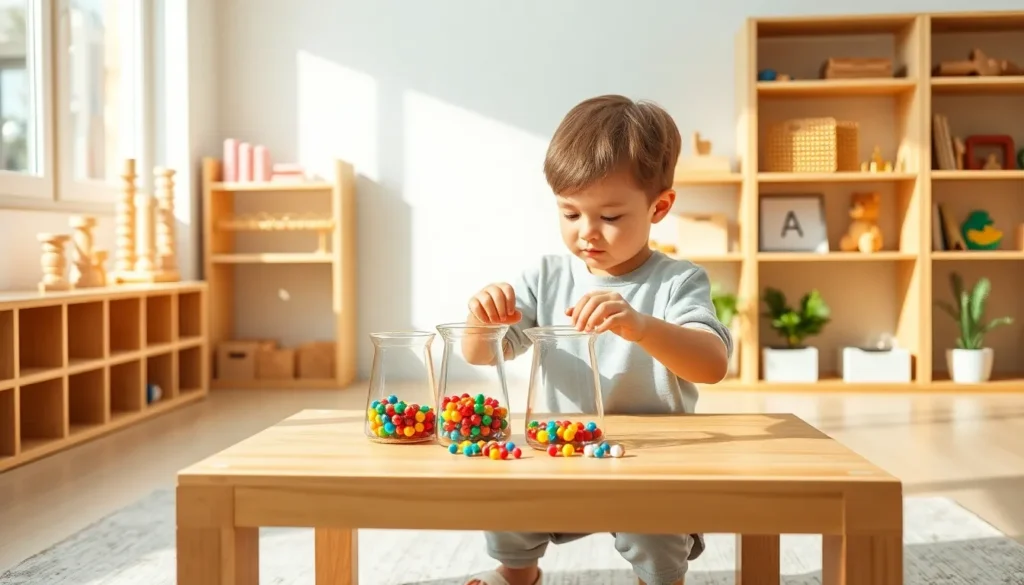

Montessori examples show how children learn best through hands-on, self-directed activities. This educational approach respects each child’s natural curiosity and developmental pace. Parents and educators use Montessori methods to build independence, focus, and a genuine love of learning.
This guide covers practical Montessori examples for toddlers, preschoolers, and elementary-age children. It also explains how families can apply these principles at home. Whether someone is new to Montessori or looking for fresh activity ideas, these examples offer clear starting points.
Table of Contents
ToggleKey Takeaways
- Montessori examples emphasize hands-on, self-directed activities that respect each child’s natural curiosity and developmental pace.
- Practical life activities like pouring, spooning, and dressing frames help toddlers build fine motor skills and independence.
- Preschoolers learn academic concepts through concrete materials such as sandpaper letters, golden beads, and the pink tower.
- Elementary-age children explore subjects through the Great Lessons and integrated projects that connect multiple disciplines.
- Parents can apply Montessori principles at home by creating accessible spaces, involving children in daily tasks, and offering open-ended materials.
- Respecting a child’s pace and allowing them to complete tasks independently builds confidence, coordination, and responsibility.
What Is the Montessori Method?
The Montessori Method is an educational philosophy developed by Dr. Maria Montessori in the early 1900s. It centers on child-led learning within a prepared environment. Teachers act as guides rather than lecturers. Children choose their activities and work at their own pace.
Key principles of Montessori education include:
- Respect for the child: Adults trust children to make meaningful choices about their learning.
- Prepared environment: Classrooms feature organized, accessible materials that invite exploration.
- Hands-on learning: Children manipulate physical objects to understand abstract concepts.
- Mixed-age groupings: Younger children learn from older peers, and older children reinforce knowledge by teaching.
- Uninterrupted work periods: Long blocks of time let children concentrate deeply on tasks.
Montessori examples translate these principles into specific activities. A toddler might pour water between pitchers. A preschooler might trace sandpaper letters. An elementary student might research a country and present findings to the class. Each activity builds skills while honoring the child’s independence.
This method works because it matches how children naturally develop. They want to touch, explore, and do things themselves. Montessori examples give them that opportunity in structured, purposeful ways.
Montessori Examples for Toddlers
Toddlers (ages 1-3) are in a sensitive period for movement, language, and order. Montessori examples for this age focus on practical life skills and sensory exploration.
Practical Life Activities
Practical life activities teach coordination and self-care. These Montessori examples work well for toddlers:
- Pouring: Transferring dry beans or water between small pitchers strengthens fine motor control.
- Spooning: Moving objects from one bowl to another with a spoon prepares hands for writing.
- Dressing frames: Buttoning, zipping, and snapping on practice boards builds independence.
- Washing hands: Following a multi-step routine teaches sequence and hygiene.
- Folding cloths: Simple folding exercises develop concentration and precision.
Sensory Activities
Sensory work helps toddlers process information about their world:
- Sorting by color: Grouping objects by color sharpens visual discrimination.
- Texture boards: Feeling rough, smooth, soft, and hard surfaces builds sensory vocabulary.
- Sound cylinders: Matching containers by the sounds they make trains auditory skills.
Language Development
Montessori examples for language at this age include:
- Object-to-picture matching: Connecting real items to photographs builds vocabulary.
- Naming baskets: Collections of themed objects (farm animals, fruits) encourage conversation.
- Simple books: Board books with real photographs support language absorption.
These Montessori examples let toddlers participate in real tasks. They feel capable and connected to their environment.
Montessori Examples for Preschoolers
Preschoolers (ages 3-6) enter what Montessori called the “absorbent mind” phase. They soak up information rapidly. Montessori examples for this age introduce academic concepts through concrete materials.
Language and Literacy
Montessori preschool classrooms use specific tools for reading readiness:
- Sandpaper letters: Children trace textured letters while saying the sound. This connects touch, sight, and hearing.
- Moveable alphabet: Loose letters let children build words before they can write them.
- Metal insets: Tracing geometric shapes prepares the hand for letter formation.
- Classified cards: Picture-and-word cards expand vocabulary in categories like animals, plants, and vehicles.
Math Materials
Montessori examples for math make abstract numbers concrete:
- Number rods: Red and blue rods of increasing length represent quantities 1-10.
- Spindle boxes: Children place the correct number of spindles into numbered compartments.
- Golden beads: Single beads, bars of 10, squares of 100, and cubes of 1,000 show place value physically.
- Addition strip board: This material lets children see how numbers combine.
Sensorial Refinement
Advanced sensorial Montessori examples include:
- Pink tower: Stacking cubes from largest to smallest develops visual discrimination of size.
- Brown stair: Prisms varying in thickness teach dimension comparison.
- Color tablets: Matching and grading shades refines color perception.
These Montessori examples prepare preschoolers for formal academics. Children who work with golden beads understand addition before memorizing facts. Those who trace sandpaper letters read with less struggle.
Montessori Examples for Elementary-Age Children
Elementary students (ages 6-12) think more abstractly. Montessori examples for this age span multiple subjects and encourage research, collaboration, and deeper inquiry.
The Great Lessons
Montessori elementary programs begin with five “Great Lessons”, dramatic stories that spark curiosity:
- The Story of the Universe: Covers the formation of Earth and sets up studies in astronomy, chemistry, and geology.
- The Coming of Life: Introduces biology and the timeline of living things.
- The Coming of Humans: Explores early human history and civilization.
- The Story of Writing: Traces communication from cave paintings to alphabets.
- The Story of Numbers: Shows how humans developed mathematical systems.
These stories inspire follow-up projects. A child fascinated by volcanoes might research plate tectonics for weeks.
Academic Montessori Examples
Specific materials continue the hands-on approach:
- Stamp game: Small tiles represent place values for multi-digit operations.
- Fraction circles: Colored pieces show how fractions relate to wholes.
- Grammar symbols: Shapes identify parts of speech in sentence analysis.
- Timeline work: Children create illustrated timelines of historical periods.
- Continent studies: Research projects on geography, culture, and animals of each continent.
Collaboration and Community
Montessori examples at this level often involve group work. Students might plan a class garden, organize a bake sale, or produce a play. These projects teach planning, cooperation, and real-world problem-solving.
Elementary Montessori examples connect knowledge across subjects. A study of ancient Egypt might include geography, art, history, and math (calculating pyramid dimensions). This integrated approach helps children see how learning applies to real life.
How to Apply Montessori Principles at Home
Families don’t need a classroom to use Montessori examples. Simple changes create a Montessori-friendly home environment.
Create Accessible Spaces
Children thrive when they can reach what they need:
- Place snacks on low shelves so children can serve themselves.
- Store clothing in low drawers or baskets for independent dressing.
- Keep child-sized cleaning tools (broom, dustpan, spray bottle) available.
- Set up a low hook for coats and a stool for the bathroom sink.
Involve Children in Daily Tasks
Practical life Montessori examples happen naturally at home:
- Let toddlers help load the washing machine.
- Invite preschoolers to chop soft vegetables with a child-safe knife.
- Ask elementary children to plan a meal and make a shopping list.
- Assign age-appropriate chores and let children complete them independently.
Offer Open-Ended Materials
Montessori examples don’t require expensive equipment. Simple materials work:
- Blocks, puzzles, and art supplies encourage creative thinking.
- Nature collections (shells, rocks, leaves) invite classification and observation.
- Measuring cups and kitchen scales turn cooking into math practice.
Respect the Child’s Pace
Montessori philosophy values process over product. Parents can:
- Allow extra time for children to dress themselves or pour their own milk.
- Resist the urge to correct or take over when tasks get messy.
- Observe what interests the child and provide related activities.
These Montessori examples at home build the same skills as classroom activities. Children gain confidence, coordination, and a sense of responsibility.


